At a controlled intersection, ask two separate questions: may this road user enter, and if entry is permitted, whose path must clear first? Permission to move does not automatically grant priority.
Read the controlling signal in layers
Start with the traffic controller. With both arms extended sideways or lowered, non-rail traffic from either side may go ahead or turn right; traffic at the chest or back stops. With the right arm forward, traffic from the left may use every lawful direction, traffic at the chest may turn right only, and traffic from the right or back stops. Then apply lane arrows, mandatory directions and path conflicts.
| Signal | What it establishes |
|---|---|
| Ordinary green | Entry is permitted, but conflict and clearance duties remain |
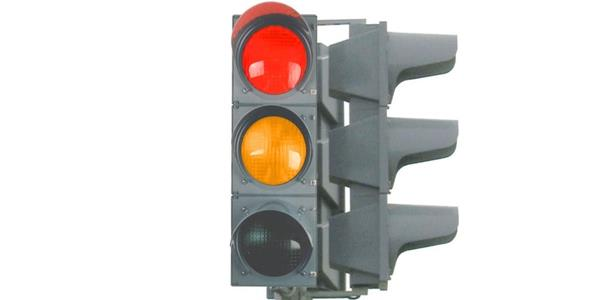
| Red and yellow together | Movement stays stopped; green is about to appear |
| Flashing round green | Movement remains permitted while the interval ends |
| Green supplementary arrow with red main signal | The arrow conditionally permits movement; yield to released traffic |
| Reversible-lane signal | A red X closes; a green arrow opens; darkness gives no permission |
| Four white lunar lights | The lower light works with an upper route light for reserved-lane traffic |
After permission, trace the paths. Turns may cross oncoming traffic, trams, pedestrians or cycle routes. Check a tram's priority only after applying duties created by its own manoeuvre. A tram using a supplementary arrow beside red must yield like any other vehicle on that signal. If a tram changes lanes or turns across a path already occupied by another road user, the tram must first yield to that road user; an indicator creates no priority. Do not enter on green if congestion would block the intersection. A turn or U-turn may enter only when it can clear the junction. Let traffic and pedestrians already inside clear.
Official-exam nuances
- On the official exam, the accepted answer for the supplementary-arrow scene that names a bus is that the bus driver gives way.
- On the official exam, the accepted answer for the sideways-arm scene with five cars is that blue, red and green may move, while yellow and white stop.
- On the official exam, the accepted answer for the other diagonal sideways-arm scene is that the yellow and red cars may move.
- On the official exam, the accepted answer for the patrol-car and bus scene is that the patrol car may travel in all directions and the bus only right.
- On the official exam, the accepted answer for the controller holding a hand near the face is that only the bus may continue.
- On the official exam, the accepted answer for the crossing paths of a car and a turning tram is that the car driver gives way to the tram.
- On the official exam, the accepted answer for driving straight beside a tram is to give way to the tram.
- On the official exam, the accepted answer for a right turn from the controller's chest side is yes, without obstructing the pedestrian.
- On the official exam, the accepted answer for the car turning right beside a tram that is signalling across the car's occupied path is that the car is not obliged to give way.
- On the official exam, the accepted answer for the depicted chest-side right turn facing another car is to drive through first.
- On the official exam, the accepted answer for the depicted reverse from the chest side is that there is no duty to give way to the other driver.
- On the official exam, the accepted answer for the chest-side approach with the left-pointing one-way sign is straight only.
- On the official exam, the accepted answer for the chest-and-back approach scene is that the two pictured vehicles may continue.
- On the official exam, the accepted answer for the lowered-arms scene with a roadside direction sign is straight and right.
- On the official exam, the accepted answer for the lowered-arms scene with a right-turn lane arrow is right only.
- On the official exam, the accepted answer for the chest-side scene with one arm extended sideways is movement in all directions.
Common mistakes
- Treating every green element as priority. A supplementary arrow beside red gives permission with a yielding duty.
- Reading the controller as a flat symbol. The four orientations produce different permissions.
- Stopping after permission. Turns can still cross vehicles, cyclists or pedestrians.
- Confusing signal systems. Lane control and white-lunar route signals govern different traffic from ordinary lights.
- Letting signs override active control. The controller governs first; mandatory directions still limit the permitted path.
- Using an arrow to reach a farther opening. A right turn enters the nearest available carriageway unless another control says otherwise.
Try it
What do yellow and red traffic lights on at the same time mean?
- Allowed to start moving.
- Prohibit traffic and warn that a green light will soon be on.
- A vehicle with special sound or flashing light signals is approaching the intersection.
Are you obliged to give way to the tram driver in this situation?
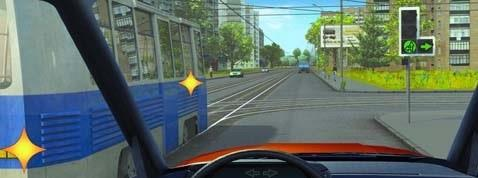
- Obliged
- Not obliged