For every manoeuvre, decide whether the movement is lawful and who must wait while it is made. Trace each path first, then apply the most specific control or manoeuvre rule to every conflict.
A four-step conflict check
First identify the movement: starting, changing lane, turning, turning around, backing, entering from adjoining property, or continuing in an established lane. Second, read signals, signs, plates, lane arrows and markings; a specific control comes before a general default. Third, draw the path through every occupied lane, rail line, cycle route and pedestrian route. Fourth, ask which vehicle is entering or crossing a path already in use. That driver normally yields. Only when no specific control or manoeuvre duty settles an intersecting pair do you use the right-hand rule.
| Situation | Decision rule |
|---|---|
| Starting, merging or changing one lane | Yield to traffic already established in the destination path |
| Simultaneous lane changes toward one another | The left-hand vehicle yields to the vehicle on its right |
| Turning across another route | Clear every conflicting vehicle and tram route, as well as paths used by people walking or cycling |
| Route vehicle leaving a stop | Its special priority depends on a marked stop in a populated area; the driver still checks that others yield |
| Narrow passage with opposing-arrow signs | The blue sign with the large white arrow gives its approach priority; the red-bordered sign requires its approach to wait |
Position is part of the manoeuvre. Prepare from the corresponding outer lane unless a lane arrow, another marking, a dedicated deceleration lane or the roundabout-entry rule permits or requires a different position. For a turn-around or backward movement, separate a categorical place restriction from a visibility condition. Sight distance of 100 metres can make an otherwise permissible turn-around possible; it never cancels a ban attached to a crossing, bridge, tunnel, railway crossing or public-transport stop.
Official-exam nuances
- On the official exam, the accepted answer for changing lanes after overtaking in the right lane is the question-shaped sentence itself rather than yes or no.
- On the official exam, the accepted answer for a driver continuing in a lane while another enters from the right is that the continuing driver must yield.
- On the official exam, the accepted answer for the depicted right turn under the supplementary arrow is no.
Common mistakes
- Leaving adjoining property while checking only vehicles. The driver must also protect people walking or cycling across the exit.
- Giving every route bus automatic priority. The departure rule requires a marked stop in a populated area and does not override an active prohibition.
- Ignoring a deceleration lane. Where one is provided for the turn, enter it before slowing and turn from that lane.
- Treating an indicator as permission. It communicates intention but cannot cancel a yielding duty or a movement restriction.
- Using clear sight to cancel a place-based ban. A crossing, bridge, tunnel, railway crossing or protected stop remains restricted even when the road is empty.
- Checking only the nearest vehicle during a turn. Trace vehicle, tram, pedestrian and cycle paths separately before moving.
Try it yourself
The driver of which vehicle has first priority?
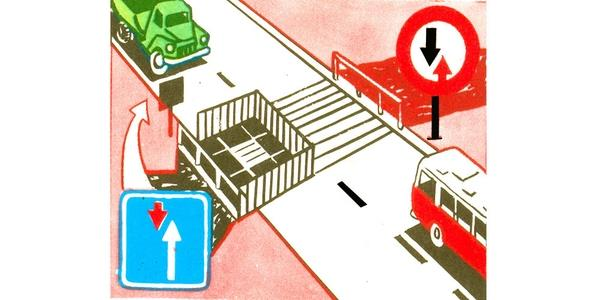
- Truck driver
- Bus driver
In which picture does the driver of the blue car have the priority right of driving over the other driver?
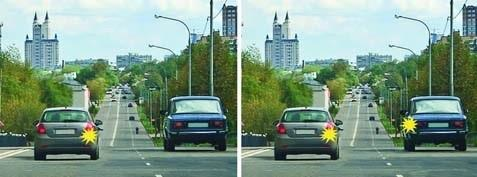
- Left
- Right
- Both
Is it allowed to reverse in this place?
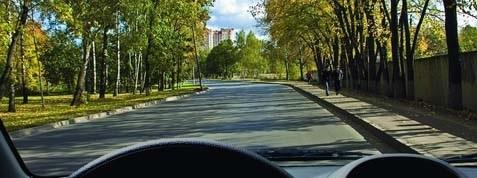
- Yes
- Allowed if visibility is more than 100 meters
- No