Sign questions in this bank rarely ask for a name from a catalogue. They show one sign, a row of numbered cards, or a street scene, and ask which sign carries a duty, what the plate under it changes, and how far it reaches.
The system behind the pictures
Read every sign in two steps: first the outline and colour, which fix the group and the strength of the message, then the pictogram, which fixes the detail. A pictogram read correctly but filed under the wrong group still produces a wrong answer.
| Group | What you see | What it does to you |
|---|---|---|
| Warning | Triangle on its base, red border, black drawing on white | Announces a hazard ahead, nothing more |
| Priority | Empty triangle on its point, red octagon, yellow diamond | Settles who goes first at a junction or narrow passage |
| Prohibitory | Red-bordered circle; for stopping and parking, blue field with red diagonal or cross | Takes something away: entry, manoeuvre, speed, class of vehicle |
| Mandatory | Blue circle with a white arrow, number or figure | Orders a movement or a value, not merely permits it |
| Information and direction | Blue square or rectangle with a white diagram | Describes the road: one-way, dead end, lane directions |
| Service | Blue rectangle, white inner field, symbol of the service | Points to a facility beside the road |
| Identification markings | Small panels, discs or lamps carried on the vehicle itself | Describes that vehicle or its driver, not the road ahead |
One pair sits across those lines: at a narrow passage precedence is settled by a red-bordered circle for one direction and a blue square for the other, so here the circle commands priority instead of taking something away, and the square settles precedence instead of describing the road. Diagonal lines across a sign end what it was doing, and a red diagonal across a blue square ends the arrangement it described. Distance matters too: a warning stands 50 to 100 metres before its hazard inside a settlement, 150 to 300 metres outside one.
Under a sign lives the plate, a white rectangle with a black border that edits the sign above it. A plate can attach the sign to a class of vehicle, a way of standing at the kerb, a kind of day, or wet weather. A plate naming the kind of vehicle reaches wider than its drawing: a car there also takes in goods vehicles at or below 3.5 tonnes of maximum permissible weight, while a goods-vehicle drawing speaks to the heavier ones. The plate prescribing how to stand at the kerb works differently: the car it draws extends to motorcycles as well. A number on a plate takes its meaning from the arrows around it.
Where the answers are lost
- Treating every speed number as a ceiling. The frame decides: a red-bordered circle caps the speed, a blue circle demands it, a blue square only advises it. Distractors swap the three freely, and a plate can still tie the value to one lane or a wet surface.
- Expecting a crossed-out sign to end more than it does. Diagonal lines close only the regime of the symbol under them: a struck-out speed value, pair of vehicles, lane arrangement and priority diamond are not interchangeable. Distractors offer the wrong one, or a partial cancellation where a general one is asked.
- Turning a warning triangle into an order. Distractors ask you to give way to a tram, a cyclist or crossing traffic because a triangle draws them. A triangle only announces; the duty comes from a priority sign — the empty triangle on its point, the red octagon, or the red-bordered circle of a narrow passage.
- Confusing the two signs of a narrow passage. Both carry a downward arrow at the left and an upward one at the right, so only frame and colour separate them: inside the red-bordered circle the waiting is yours, on the blue square the passage is yours.
- Reading a plate's number without reading its arrows. Arrows at both ends measure a stretch of road, a bare number the way to where the sign starts to bite, an upward arrow above the number the zone it covers. Distractors trade the length of a section for the distance to its start.
- Reading a pictogram as a portrait of one vehicle. The drawing names a class the rules define, usually wider than the picture: a car inside a red circle reaches every mechanical vehicle. The rules also draw their own limits, with separate treatment for trailer combinations and route vehicles. Distractors shrink the class to the vehicle drawn, misplace the 3.5-tonne line, stretch a restriction over traffic it never named, or tie an exemption to the speed of the vehicle in front.
Try it yourself
Which of the following signs is placed just before crossing the traffic area?
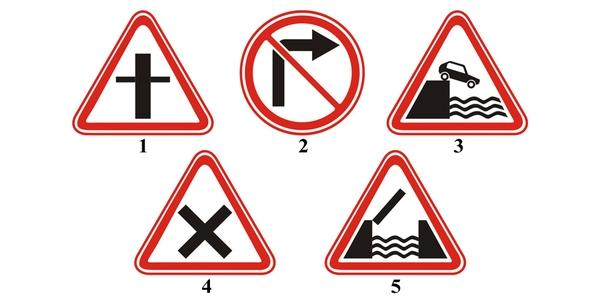
- 1
- 2
- 3
- 4
- 5
What does this identification mark mean?
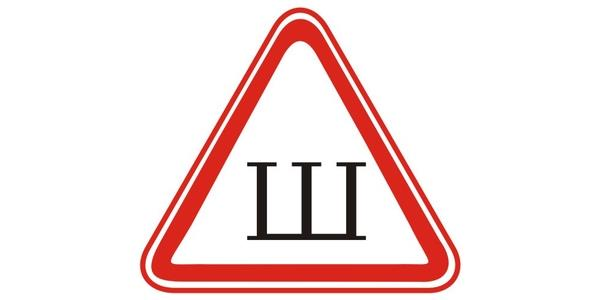
- There is a section of road ahead that has a bump in the roadway.
- Ahead is a section of road with three lanes for traffic in that direction.
- Mechanical vehicle is equipped with tires with spikes.
In what direction can you continue driving at this intersection if you are driving a truck with a maximum permissible weight of 3.5 tons?
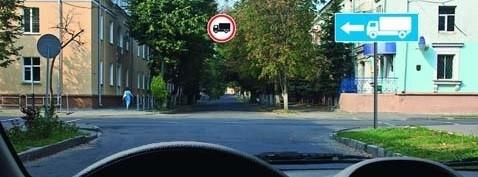
- Only left
- Right, left or opposite
- Any