Signals, overtaking, lighting and railway crossings often place several warnings in one situation. Identify the controlling device or manoeuvre first, then decide whether it warns, grants priority or imposes a prohibition.
Classify first, then apply the rule
Start with four checks: What signal is actually operating? Is the vehicle changing direction or position? Is the location itself protected? Is a more direct stop command present? This prevents a conspicuous beacon, an indicator or a slow vehicle from distracting you from the rule that controls the situation.
| Situation | Decision rule |
|---|---|
| Special vehicles | A blue beacon claims priority only together with the special audible warning. Blue and red with that sound also requires slowing and yielding to the protected group. A stationary red flashing beacon means stop until permission is given. Amber or yellow warns of a hazard but gives no priority; moon-white equipment is an alarm, not a traffic advantage. |
| Direction warnings | Signal before starting, leaving the roadside, changing lanes, turning or stopping. Give useful advance notice without misleading anyone. A hand warning ends immediately before the movement; an electric indicator ends when its announced movement is complete. A signal communicates intention and never creates priority. |
| Overtaking | Before entering an opposing lane, verify both a clear distance for the entire pass and that nobody has already begun passing you. Location prohibitions still control: do not overtake at an intersection, pedestrian crossing, railway crossing or within the final 100 metres before the rails. A low speed does not cancel those bans. |
| Lighting and emergencies | At night or in insufficient visibility, use dipped or main headlamps as conditions permit and dip main beam by 150 metres from an oncoming vehicle. Rear fog lamps are for insufficient visibility, not darkness alone. After an emergency stop, place the warning triangle at least 15 metres away in a built-up area and 30 metres away outside one. |
At a railway crossing, combine every source of control: the attendant, lights, barrier, signs and markings. A direct stop command is not cancelled by an apparently open route or by seeing no train. Enter only at a designated crossing and only when there is room to clear the tracks completely. If forced to stop on the rails, the general alarm repeats one long horn blast followed by three short blasts.
For direction signals, distinguish the road from the vehicle. Following a bend while remaining in the same lane is not a turn. By contrast, a real turn or lateral shift still needs a signal even when a sign makes that direction compulsory, when the manoeuvre happens in a car park, or when no other road user is visible.
Official-exam nuance
On the official exam, the accepted answer for the situation that asks what the overtaking vehicle must do is that it must not obstruct the one overtaking by increasing speed or taking another hindering action. In the general rule, that duty belongs to the driver being overtaken.
Common mistakes
- Treating every flashing beacon as priority. Amber warns of a hazard, and moon-white signals an alarm; neither gives a traffic advantage.
- Assuming that an indicator earns the manoeuvring driver a place. It only announces an intention: a left turn, lane change or return after a pass still has to yield whenever the ordinary rule requires it.
- Letting vehicle speed override an overtaking ban. A slow bus, truck, road train or motorcycle does not make a pass lawful at an intersection, pedestrian crossing or railway crossing.
- Using the same timing rule for hand and lamp signals, or signalling every road bend. Give advance warning for an actual manoeuvre; withdraw a hand before moving, cancel a lamp when its movement finishes, and do not indicate merely to follow your lane around a curve.
- Using one lamp mode for every dark road. Choose dipped or main beam to preserve visibility without glare; use rear fog lamps only in insufficient visibility.
- Looking for one permissive railway cue and ignoring a prohibition. No visible train, raised barriers or dark lamps cannot override a red light, a closed barrier, an attendant's stop gesture, or a blocked exit beyond the rails.
Try it yourself
At what distance from the vehicle set the sign "Emergency stop"?
- In populated areas - not less than 15 m, outside populated areas - 30 m.
- In populated areas - at least 10 m, outside populated areas - 20 m.
- In settlements - at least 5 m, outside settlements - 10 m.
In which case is it allowed to overtake the oncoming lanes on roads with one lane in each direction?
- Only when the oncoming zone free with sufficient distance?
- Only when you do not overtake
- Both conditions are required to be ensured.
Are you required to give way to the driver coming out of the adjacent area who turned on the special sound and light signals?
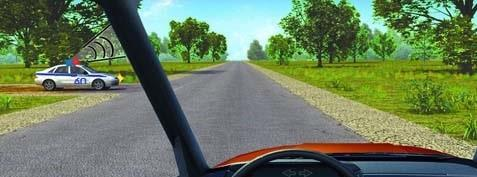
- Not required.
- Required.