At an intersection, decide who moves first, who waits and which non-conflicting movements may share one stage. Ignore vehicle colour and apparent closeness; build the order from the controls and the actual paths.
A four-layer decision
| Layer | Question to ask | Decision |
|---|---|---|
| Control | Is an operating signal assigning movement? | Obey it first. Flashing yellow makes the junction unregulated, so continue to signs and ordinary priority rules. |
| Road status | Which arms form the priority route on the sign and plate? | Let conflicting priority-road traffic clear before subordinate traffic. Vehicles sharing one status still need another rule. |
| Equal status | Who approaches from the right, and whose turn crosses an oncoming path? | Yield to a conflicting road user approaching from the right-hand side. A left turn also yields to conflicting oncoming traffic continuing straight or turning right. |
| Special conflict | Is there circulating traffic, a tram, a crossing pedestrian or cyclist, or a U-turn? | An entrant yields to circulating traffic; a tram precedes non-rail traffic on equivalent roads; a turning driver protects people using foot crossings and riders on cycle routes; a U-turn must not obstruct others. |
Now remove movements that do not conflict. Opposing or parallel paths may sometimes proceed in the same stage, while vehicles in one lane preserve their queue order. A direction indicator announces a path but grants no priority. Vehicle size, closeness to the centre and an amber beacon do not create priority either. A hard-surfaced road is treated as the main road against an unpaved branch when no sign reverses that relationship.
Apply the layers again after each movement clears: the road user who had to wait may become next. On a route diagram, thick and thin branches show the priority route. A warning or one-way sign does not itself establish priority. If darkness, snow or mud hides the surface class and no sign resolves it, treat your own approach as minor.
Official-exam nuances
- On the official exam, the accepted answer for the scene showing two buses and one car is the sequence trolleybus, ordinary automobile, bus.
- On the official exam, the accepted answer for the two separate traffic scenes is that the yellow car goes third.
- On the official exam, the accepted answer for the priority question whose named road users are absent from the scene is the bicyclist.
- On the official exam, the accepted answer for the depicted left turn facing an oncoming truck is to stop at the crossroads first.
- On the official exam, the accepted answer for the depicted right turn facing an oncoming left-turning car is to stop at the crossroads first.
- On the official exam, the accepted answer for entering a congested intersection is that entry is allowed when making a turn or U-turn.
Common mistakes
- Applying right-side priority before comparing road status. A road user on a subordinate approach still waits for conflicting priority-road traffic.
- Reading every nearby sign as a priority sign. Warning, direction and one-way signs can shape a route without establishing which road is primary.
- Ignoring the route plate. The thick branch may bend through the junction, so visual straightness does not determine the priority route.
- Giving a larger vehicle an advantage. Size and class do not replace the control, road-status and conflict rules.
- Forcing every movement into a separate stage. Lane-preserving paths that do not cross can proceed together.
- Assuming your road is primary when its surface is hidden. Without a resolving sign, darkness, snow or mud requires you to treat your approach as minor.
Try it yourself
When passing the crossroads in this situation
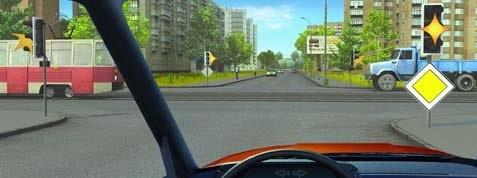
- You have the right to pass first
- You have to give way to the tram driver
- You have to give way to the truck driver
- You have to give way to all the drivers
The driver entering this intersection
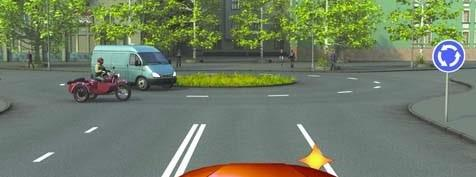
- Has a priority driving
- Ought to give way to the truck
- Ought to give way to both drivers
In this situation you ought to give way to
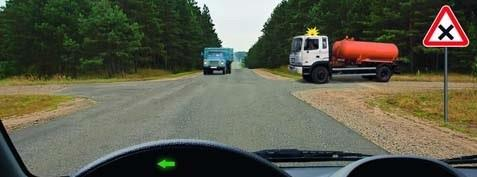
- Both drivers
- Only the oncoming truck