Intersection questions become easier when you read the active control, the movement being attempted and the conflict that must be protected. Use the scene details as premises, then apply the matching California rule without importing a rule from a different signal or road layout.
Start with control and stopping place
A steady circular red requires a complete stop. A right turn may then be made only when no sign prohibits it, the way is clear and required yielding is complete. Straight-through movement still waits for a permitting signal. A steady red arrow is different: the movement indicated by the arrow waits until a signal permits it. At a stop control, locate the stopping boundary in order. Stop at the limit line. If there is no limit line, stop before the crosswalk. If neither exists, stop before entering the intersecting roadway. The physical hierarchy prevents the vehicle from occupying the space that the next rule is meant to protect.
| Conflict | California reading |
|---|---|
| Vehicle already entered from another highway | The approaching driver yields under the applicable general intersection rule. |
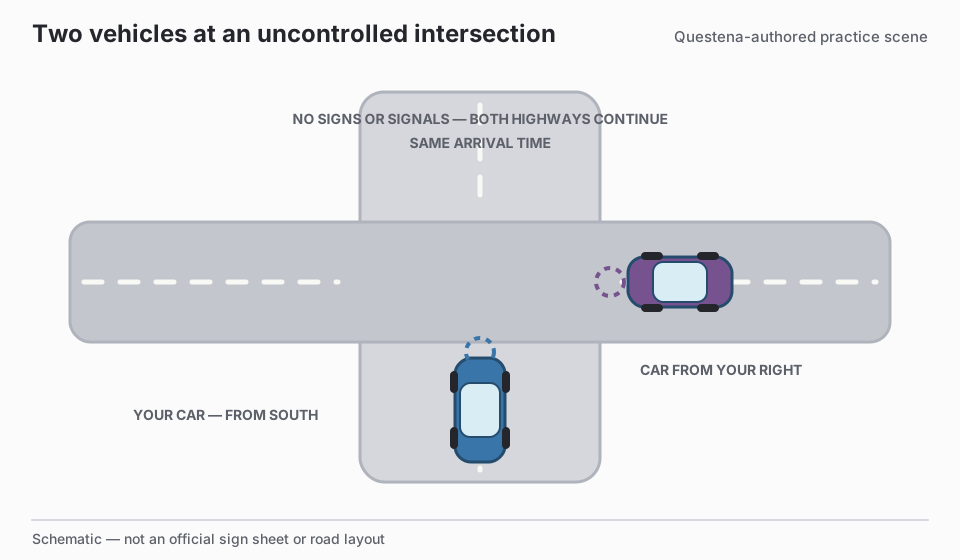
| Vehicles enter from different highways at the same time | The driver on the left yields to the vehicle on the immediate right. |
| One highway terminates at the intersection | Traffic on the terminating highway yields to traffic on the continuing highway. |
| Left turn or U-turn across opposing traffic | Judge whether opposing traffic can become hazardous at any time during the whole movement. |
| Pedestrian within a crosswalk | Yield and use due care; do not race the pedestrian's path. |
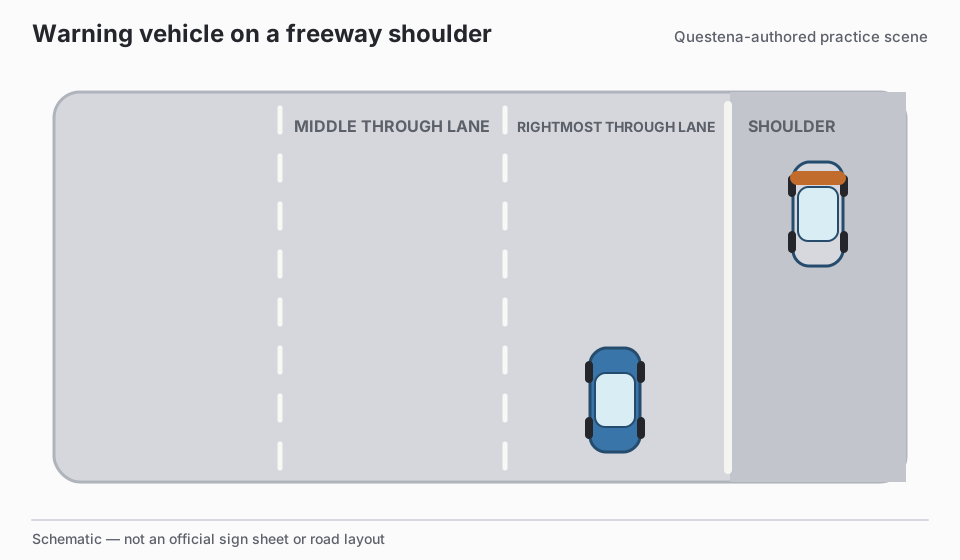
| Stationary warning vehicle on a freeway | Create a lane of space when the move is available, practicable and safe; otherwise slow for conditions. |
For same-time arrivals at an applicable uncontrolled intersection, identify left and immediate right from each driver's approach rather than from a map compass. Keep the terminating-highway rule as a separate branch: a driver coming from the road that ends gives way to a vehicle on the continuing highway. For a left turn or U-turn, scan the full path and duration of the turn. Opposing traffic matters when it is close enough to be hazardous at any time during that movement, and yielding continues until reasonable safety is possible.
Crosswalk duties are also two-sided without cancelling each other. A driver yields to a pedestrian crossing within a marked or unmarked crosswalk and uses due care. A pedestrian must not suddenly enter the path of a dangerously close vehicle, but that separate immediate-hazard duty is not permission to pass ahead of someone already crossing. On a freeway, warning lights on a stationary covered vehicle trigger another two-branch decision: move into a suitable lane away when practicable and safe; otherwise reduce speed to a reasonable and prudent level for conditions.
The traps
- Treating a stop at a circular red as permission to continue straight. The stop can precede a permitted turn, but straight-through movement still waits for a permitting signal.
- Stopping beyond a marked crosswalk when no limit line is present. The stopping point is before the crosswalk, not inside or beyond the pedestrian space.
- Checking opposing traffic only at the start of a left turn. The hazard test covers any time during the whole turning movement.
- Trying to pass ahead of a pedestrian already within a crosswalk. The driver yields and uses due care; the pedestrian's separate immediate-hazard duty does not cancel that obligation.
Try it
Assume the ordinary uncontrolled-intersection rule applies to the situation in the figure and no special exclusion applies. Who yields?
- The other car yields because it approaches from the eastern side of the intersection
- Neither yields because both highways continue
- The driver's car yields to the car on its immediate right
- Both cars must reverse away from the intersection
The middle lane shown in the figure is available, and moving into it is practicable, lawful, and safe. What should the approaching driver do?
- Remain in the rightmost lane at the same speed
- Move safely into the available middle lane
- Stop beside the warning vehicle on the shoulder
- Accelerate past before another car reaches the middle lane