Table questions here rarely ask you to describe a table. They name one item and one property and expect a single cell, they ask which item leads or trails, or they ask for something the table never prints — a difference, a total, a share, a length of time — which you build from the cells that are there.
Reading a table on purpose
Start above the data. The title says what is being counted and for what set of things; the column headings say in what unit and per what. A heading can carry a unit, a currency, a period or a per-something phrase that governs every number under it, so two columns of one table usually hold two different quantities. Before you compare two numbers, check that they sit under the same heading; combining numbers from different columns is meaningful only when those columns measure the same thing in the same unit — the two branches of one count, the two ends of one interval. Then work from the question backwards into the grid: it names a row key and a column key, so locate both labels first and read only where they meet. Reading a cell by position, by the row you happen to be looking at, or by the number that stands out is how a right cell turns into a wrong answer.
| What the question asks for | How the table gives it |
|---|---|
| One named item, one named property | A single cell where that row and that column meet |
| Which item leads or trails | One whole column, top to bottom, in that column's unit — unless the quantity is split across columns, and then you assemble it first |
| A difference, a total, a share or an interval | Two or more cells, combined by you; the table never prints it |
| Whether given statements are supported | Each statement checked on its own, against the cells it names |
| Anything about a group of rows | Every row of that group, including rows whose cell is a word |
Select-all questions are several small questions sharing one table, so check each statement separately and only against the cells it actually names. The statement's own words set the standard of proof: every, all and only fail on a single exception anywhere in the column, while longest and shortest are about an interval and therefore need both of its ends. A cell holding a word instead of a number is data as much as the numbers are — a row is not missing merely because it carries no figure.
Where the answers are lost
- Comparing under the wrong heading. The row is right and the number is real, but it was read from a column the question never named. A row that leads in one column has no claim on any other column, and a large number in a neighbouring column is not evidence about the one you were asked for.
- Answering an altogether question from a single column. Where a table splits one quantity across several columns, the leader of one part is often not the leader of the sum. Add first, compare second — and add for every candidate row, not only for the one that caught your eye.
- Calling it a tie because the parts look alike. Columns built from similar-looking numbers still add up to different totals; the option saying everything is equal stays plausible exactly as long as the arithmetic stays undone.
- Testing an every or all statement on the rows you happened to read. One row behaving differently sinks the statement, and that row is rarely the first one. Run the whole column before accepting a universal claim, and before rejecting one.
- Judging an interval by one of its ends. The row whose interval ends latest need not be the row with the longest span. Subtract both cells for every row, then rank.
Try it yourself
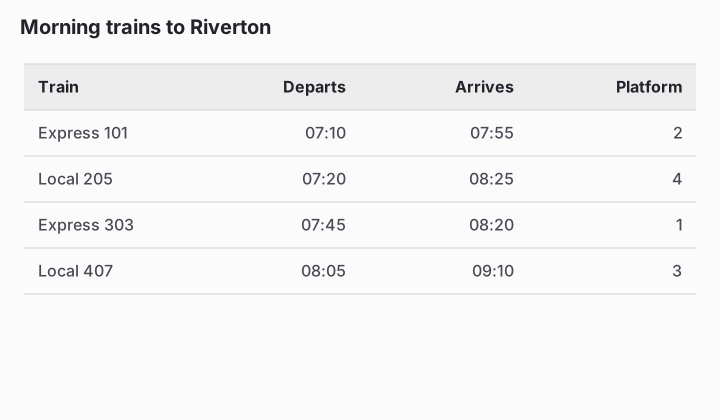
Based on the table, which train has the shortest journey time to Riverton?
- Express 303
- Express 101
- Local 205
- Local 407
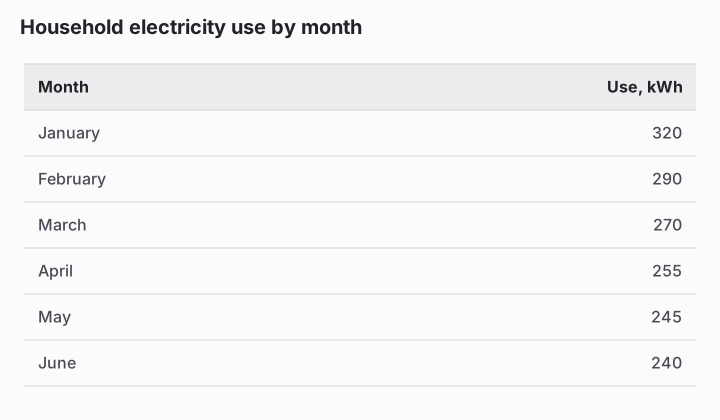
Based on the table, how many more kWh of electricity were used in January than in June? Enter the number of kWh.
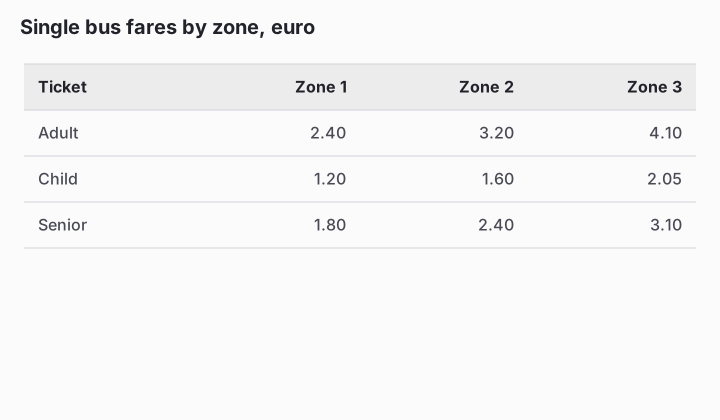
Based on the table, what is the total fare for one adult and one child travelling in Zone 2?
- €5.25
- €4.80
- €3.60
- €6.40